

When “Good Enough” Quietly Replaces Conversion
Sixth Sunday in Ordinary Time — the law fulfilled, not relaxed

There is a moment most people in parish ministry recognize immediately, even if they would struggle to name it out loud.
It usually happens late in the week, perhaps during a rehearsal that technically went fine, or while reviewing music plans that meet every external requirement, or while hearing oneself say, with a tired sincerity, this will work. Nothing is wrong. And yet, nothing feels fully true.
It is not failure that unsettles us here, but adequacy.
The readings this Sunday place us precisely inside that discomfort. Sirach refuses to let us hide behind inevitability or temperament or circumstance. Life and death, fire and water, are set before us—not as abstractions, but as real moral and spiritual options. God, Sirach insists, does not command injustice, nor does He excuse sin by calling it realism. Choice is not removed by complexity; it is intensified by it.
Paul, writing to Corinth, sharpens the point. The wisdom that forms the Church is not the cleverness of systems or the pragmatism of survival, but something older and deeper, a wisdom hidden in God before the ages, revealed not to the self-assured but to the receptive. This is not anti-intellectualism; it is an insistence that true understanding requires formation of the heart as much as competence of mind. One can know the mechanics of ministry and still miss its meaning.
Then Christ speaks, and the ground becomes unsteady. The law is not abolished, not softened, not reduced to minimum compliance. It is fulfilled. Which means it moves inward. Anger becomes murder’s seed. Desire becomes adultery’s root. Words become vows. Integrity becomes indivisible. Jesus does not lower the bar to make righteousness achievable; He raises it to reveal how much we need to be remade.
For those entrusted with the Church’s song, this is not theoretical. We handle the law every week, not only in texts and rubrics, but in habits, standards, and expectations. Over time, it becomes dangerously easy to substitute correctness for conversion, execution for obedience, planning for prayer. Music can remain respectable while losing its edge, reverent while becoming cautious, functional while no longer demanding anything of the people who offer it—or the people who sing it.
The Psalm dares to bless those who love the law, not merely follow it. “Open my eyes,” the psalmist prays, “that I may consider the wonders of your law.” Wonders, not limits. Depth, not constraint. The law, rightly received, is not a fence but a form—a shape that trains desire until the good becomes not just possible, but natural.
This has concrete implications. Formation in sacred music cannot be episodic, reactive, or purely technical, because the Gospel itself is none of those things. A choir that rehearses notes without rehearsing truth will eventually flatten both. A cantor who proclaims without interior alignment will feel the dissonance long before anyone names it. A parish that treats beauty as optional will slowly catechize its people into thinking holiness is negotiable.
The Church has never sustained her musical tradition through inspiration alone. She has relied on memory, discipline, and the patient transmission of judgment—what to sing, how to sing, and why this, here, now. That kind of formation does not happen accidentally. It requires continuity, mentorship, and a willingness to be shaped over time by something greater than immediate need.
Christ’s words at the end of the Gospel are uncomfortably simple: let your yes mean yes. Integrity, in the biblical sense, is wholeness. For those who serve the liturgy, the question is not whether we are doing enough, but whether what we are doing is integrated—whether our musical choices, rehearsal practices, and standards of excellence are aligned with the depth of the mystery we claim to serve.
The law has been fulfilled. Which means the invitation is not to relax, but to go deeper—and to allow ourselves, patiently and deliberately, to be formed for that depth.
Ars Musica Sacra is a reader-supported publication. To receive new posts and support our work, consider becoming a free or paid subscriber.
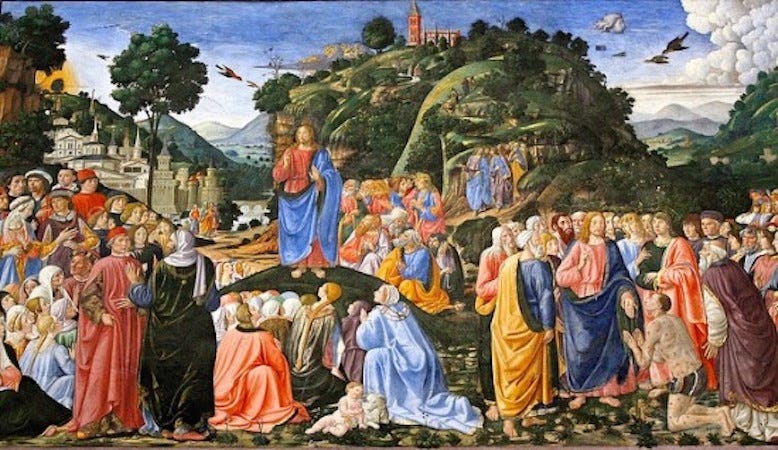
Feast Day Spotlight
This Sunday continues the Church’s extended meditation on Christ as teacher, not merely interpreter of the law but its fulfillment. Historically, the early Church Fathers understood Matthew 5 as the moment where the Decalogue is revealed in its fullest, interior form—what Origen called the law written not on stone, but on the heart.
St. Thomas Aquinas later clarified that the New Law does not add more external commands, but gives the grace necessary to live the law from within, through charity formed by the Spirit. This is why the Church has always insisted that liturgical discipline and moral discipline belong together: what is sung and prayed shapes what is chosen and lived.
As Sacrosanctum Concilium reminds us, the liturgy is not a place for minimal obligation, but the primary school of Christian formation, where the faithful learn how to offer themselves rightly to God. The law fulfilled in Christ is learned, slowly, in worship.
Share these Ars Musica Sacra insights with others for the celebration of this liturgy!

Inspiration from across the internet.
My music of the week.
Ars Musica Sacra is supported by readers like you. Join our community and engage with other readers by sharing your thoughts and contributing to community discussions!


Have thoughts on what we shared here? Or maybe questions on some liturgy or theology points? Leave a comment and engage with other readers.