

Twenty-sixth Sunday in Ordinary Time
Sacred song is never the sound of ivory couches but the cry of Lazarus set to melody.
There is a quiet but piercing warning in Amos’s lament,
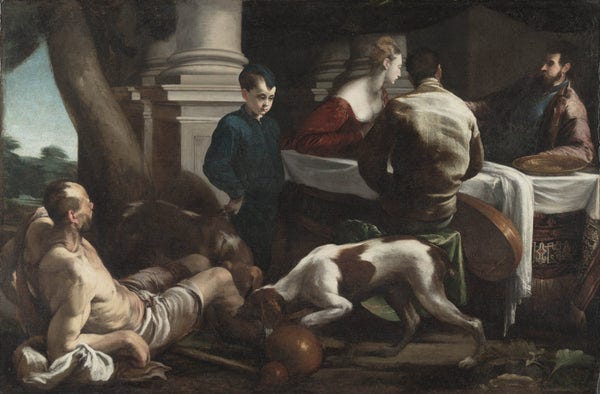
not shouted from a battlefield or whispered in secret, but announced in the ease of banquets and the strum of harps—he does not denounce violence or overt blasphemy, but complacency, the soft indulgence of those who recline on ivory couches, inventing their own songs, drinking wine from bowls, all while the ruin of Joseph goes unnoticed. It is the danger not of hostility but of indifference, the sin not of cruelty but of comfort that refuses to be moved by the suffering at the door.
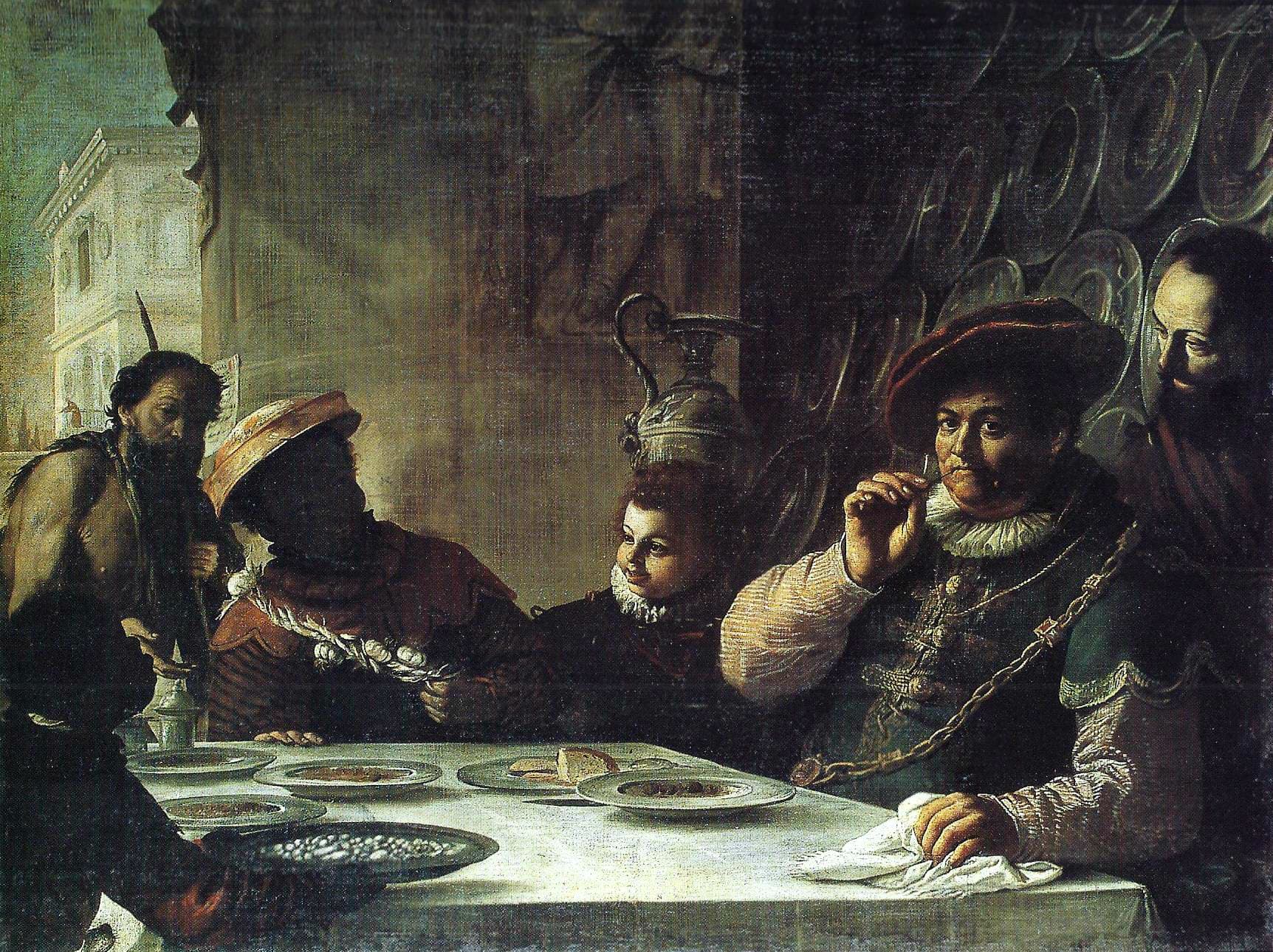
This same theme unfolds with devastating clarity in the parable of Lazarus and the rich man. Jesus does not describe a tyrant or a murderer, only a man dressed in purple and linen who ate splendidly each day while ignoring the poor, ulcerated body just outside his gate. The chasm that opens after death is only the outward expression of the chasm he had chosen all along, the gulf carved not by a single act of hatred but by a thousand silent refusals to see, to share, to love. Abraham’s words ring with both justice and sorrow: the rich man had his consolation, Lazarus his misery—now the scales are reversed, and no gesture of pity can cross the abyss.
Paul’s exhortation to Timothy stands as a sharp counterpoint to such complacency. Instead of reclining, he commands striving; instead of settling into ease, he insists on competing for the faith, pursuing righteousness, devotion, gentleness, and patience. This struggle is not frantic ambition but fidelity to the confession made before many witnesses, the confession Christ Himself offered before Pilate when He bore witness to the truth even at the cost of His life. To belong to such a Lord is to be drawn into His unapproachable light, a light that exposes the shadows of selfishness and calls us into a vigilance that refuses to sleep on ivory couches while the world starves.
For the Church’s musicians and ministers, this Sunday’s readings strike a particularly tender nerve, because the temptation to complacency is not limited to wealth or possessions—it can creep even into the sacred work of liturgy. How easy it is to treat music as an ornament to our comfort, to seek the pleasure of sound without the burden of service, to devise “our own accompaniment” rather than allow ourselves to be formed by the psalter and the chant that carry the weight of centuries of faith. St. John Chrysostom warned that luxury in worship could numb the soul, turning the temple into a theater, and he urged his people instead to let their hearts be pierced by the cries of the poor, for only then would their hymns ascend as acceptable offerings.
The Church herself has preserved this warning in her documents. Tra le Sollecitudini, Pope Pius X’s instruction on sacred music, cautioned against treating the liturgy as entertainment, insisting instead on music that fosters prayer and directs the faithful toward holiness. Music, he said, is truly sacred when it clothes the words of the liturgy with a fitting garment of sound, when it humbles itself before the mystery rather than dazzling the senses for their own sake. In other words, music that does not awaken us to Lazarus at the door risks becoming the sound of ivory couches, pleasing but hollow.
And yet, there is also promise hidden here: that song can be the very thing that bridges the chasm if it is sung in the Spirit of Christ. St. Ephrem the Syrian, the deacon-poet of the early Church, composed hymns not to flatter congregations but to open their eyes to the mysteries of God and the needs of the poor. His verses were catechesis in melody, fire in poetry, medicine for the sick of heart. He knew what Paul urges and Amos insists: that the Church sings best not when it is most comfortable, but when it sings out of compassion, when its melodies carry both the glory of heaven and the groaning of earth.
So perhaps the invitation this Sunday is simple but searing: to resist complacency, to let our music be the cry of Lazarus rather than the revelry of the rich man, to allow the psalms we sing to form us into people who see, who hear, who act. For the Lord is the One who “raises up those who are bowed down,” and if our music is to be trustworthy, it must bend in the same direction—downward toward the poor, upward toward the throne, always refusing to let comfort lull us into forgetfulness.
And maybe, if we are faithful, the music we sing here and now will carry us, like Lazarus, into the bosom of Abraham, where the sound of heaven will not be foreign, because we will have already begun to learn its melody.
Feast Day Spotlight
Color of Vestments: Green
Liturgical Context: While this Sunday is in Ordinary Time, the readings highlight a tension between wealth and neglect, comfort and vigilance. The Church uses these weeks to remind the faithful that holiness is active: it is measured in care for the lowly, justice for the oppressed, and attentiveness to God’s call in daily life.
Historical/Theological Insight: The Church Fathers frequently warned against the spiritual danger of indifference. St. Gregory the Great observed that those who indulge in earthly pleasures while ignoring the needs of the poor “feed their own appetite but starve the soul.” Music and liturgy, he noted, are meant to cultivate both devotion and moral sensitivity, not merely aesthetic pleasure.
Quote: “He who sings well prays twice.” – St. Augustine. Yet singing that neglects the cries of the poor risks becoming empty ritual; true music formation bends toward service as well as beauty.
Song Recommendations
Mass Setting - Missa Spei
Meditation - There was a Rich Man (Madrigal)
Inspiration from across the internet.
→ if you are a Lord of the Rings fan, then I think you will find this interesting!
→ after recently attending a family funeral, I think this is a great reminder of funeral attire that is tried and true
My music of the week.
1) sang this at a committal service, and although it has funny lyrics at parts, it is actually quite a lovely little piece
2) Kathleen Battle being a legend, this is a great recording of Faure’s Pie Jesu

Advent is almost upon us.
Want a simple Advent spiritual guide that will enrich your seasonal fast before the great Solemnity of Christmas? We are putting together a little something just for you!