

Twenty-second Sunday in Ordinary Time
Music teaches us humility, because every harmony begins by listening before singing.
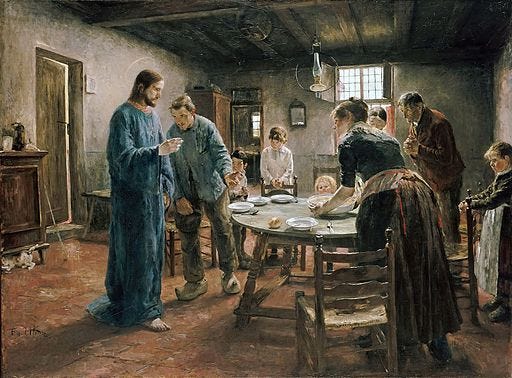
There is something strangely beautiful about how Scripture speaks of humility, not as a virtue to be acquired after every other strength is secured, but as the very ground on which all else must be built.
Sirach tells us that humility wins love more than gifts, that the higher one is lifted the more one must bow low, and that wisdom begins not with grand speech but with listening. It is almost embarrassing how counterintuitive this is to us—we instinctively seek recognition, a seat at the head table, some sign that our service is seen and applauded. Yet Jesus turns the whole image upside down, teaching that those who exalt themselves will be brought low, while the one who takes the lowest place will be called higher by the host himself.
The Letter to the Hebrews intensifies this by shifting the scene altogether: we are not drawing near to Sinai, with its fire and thunder and terrifying voice, but to Zion—the city of the living God, the festal gathering of angels, the assembly of the just, the home of Christ whose blood speaks more eloquently than Abel’s. And yet the paradox remains: we are approaching glory that cannot be earned by pride, only entered by humility. God is not impressed by our attempts to climb higher; He is moved when we stoop lower. The Kingdom’s banquet is not filled by those who demand recognition, but by the poor, the blind, the lame, the ones with nothing to repay, the ones whose only offering is need.
Sacred music has always understood this hidden law of inversion. St. Ephrem the Syrian, the great deacon and hymnographer of the fourth century, once described his hymns as “garlands of prayer” woven not for the ears of men but for the mercy of God. He wrote thousands of verses, many sung by women’s choirs in liturgy, and yet he was insistent that his words were not to display brilliance but to clothe doctrine in song for the humble of heart. There is something deeply moving about this: the Church’s greatest singers have not been those seeking applause, but those willing to be forgotten if only Christ is remembered.
The Magisterium echoes this spirit. In Musicam Sacram (1967), the Instruction on Music in the Liturgy, the Church insists that sacred song is most fitting when it “adds delight to prayer, fosters unity of minds, or confers greater solemnity upon the sacred rites.” Notice what is absent—there is no mention of personal acclaim, no reward of prestige, no exaltation of the musician’s skill. Instead, music is to bend itself low in service of the liturgy, and in that very bowing, it is exalted, because it becomes transparent to the mystery it serves.
If you have ever sung or played or directed and felt the sting of being unnoticed, this Sunday’s Gospel has something to say to you. The Host sees. The One who prepared the banquet is not blind to your hidden service, your willingness to step back so that another voice may be heard, your quiet endurance of the moments when your music falls flat or when your work goes unthanked. The Kingdom of God is not a stage with spotlights but a feast where the lowest place becomes the place closest to Christ, because He Himself has chosen it.
And perhaps this is why humility and music belong together so deeply: because music, at its best, teaches us to listen before we sing, to tune ourselves to something larger than our own voice, to take our place not above but alongside, not ahead but within. Every harmony, every unison, every pause is a small training in the humility that makes space for others. And in the liturgy, that humility is not wasted—it becomes the very sound of heaven, the echo of Mount Zion, where countless angels are already gathered in festal song, and where the poor and the meek will one day recognize their own voices in the eternal hymn.
So perhaps the invitation of this Sunday is simple: take the lower place. Let your music be more prayer than performance, more offering than display, more hidden than applauded. For in the Kingdom, it is not the loudest who are remembered, but the humble whose song has already become part of God’s dwelling among the poor.
Inspiration from across the internet.
→ a very interesting Christian history that we may not know from the east
→ my family calls me crazy, but I think this and a dark room, is the best way to work
My music of the week.
1) love this organ collaboration short
General Information
Color of Vestments - Green
Song Recommendations
Entrance - Gather Us In (M. Haugen) [sheet music] [audio]
Kyrie - Missa Spei
Gloria - Missa Spei
Responsorial Psalm - Psalm 68:4-5, 6-7, 10-11
Gospel Acclamation - Matthew 11:29ab
Offertory - Only This I Want (D. Schutte) [sheet music] [audio]
Sanctus - Missa Spei
Mysterium Fidei - Missa Spei
Amen - Missa Spei
Agnus Dei - Missa Spei
Communion 1 - The Cry of the Poor (J. Foley, SJ) [sheet music] [au3dio]
Meditation - Humility (Madrigal)
Recessional - Hail Redeemer, King Divine (ST. GEORGE’S WINDSOR) [sheet music] [audio]
