

The Solemnity of the Most Holy Body and Blood of Christ
The Bread, the Priest, and the Blessing: A Corpus Christi Reflection

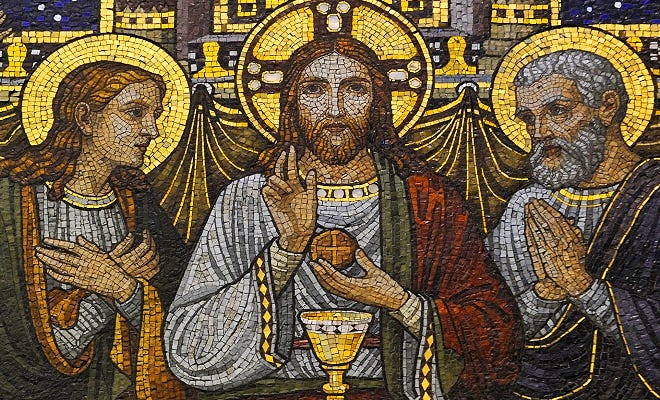
There’s something both haunting and healing about bread.
Maybe it’s because bread is so basic. It’s the food of the poor and the feast of kings. A meal shared across tables for thousands of years. It’s so ordinary that we almost take for granted it’s very existence.
And yet, on this Feast of Corpus Christi, we are told that bread—an ordinary food—is not bread at all.
It is the Body. It is Christ. It is God.
The First Time Bread Was Blessed
Before the Upper Room, before Calvary, before the Church knew what the Eucharist was, there was Melchizedek.
His story is barely more than a whisper in Genesis 14. A mysterious priest—a little background, some lineage—approaches Abram with bread and wine, and offers a blessing. It’s not just a gift. It’s a primordial liturgy, a sacred rite.
Melchizedek appears as if out of a dream, then disappears just as quickly. But his gesture lingers like incense long after the thurifer has gone cold.
Centuries later, the psalmist would write: “You are a priest forever in the line of Melchizedek.” And when Christ finally comes, the Church recognizes the echo.
Christ is that High Priest.
And the bread and wine are now His.
A Table in the Wilderness
We see it again when Jesus feeds the crowds. The moment in Luke’s Gospel is often called “The Feeding of the 5,000,” but I think it’s better to call it what it really is: a prelude to the Eucharist.
Jesus takes the bread.
He blesses.
He breaks.
He gives.
The pattern is unmistakable. He’s showing us what’s coming, even prior to the institution itself of the Most Holy Eucharist. In the chaos of a hungry crowd, the Messiah lays down the blueprint for how the Church will worship Him for millennia.
Not in abstract devotion, but in bread. Broken and given. Blessed and consumed.
Affirmation of the Institution
By the time Paul writes to the Corinthians, the institution of the Eucharist has occurred. The earliest Christian communities are gathering to “break bread,” and Paul reminds them why:
“This is my body... This cup is the new covenant in my blood.”
The same Jesus who fed crowds in the wilderness now gives Himself again—not as an example only, but as food. This isn’t just a nice metaphor. It’s the real presence. Transubstantiated. Sacramental. Divine.
And if we still doubt it, the saints and councils help us see it more clearly.
What the Saints Knew
St. Cyril of Jerusalem called the Eucharist the “medicine of immortality.” He told catechumens not to let crumbs fall to the ground—not out of superstition, but because those crumbs are Christ.
St. Thomas Aquinas, whose hymns still echo in Corpus Christi today, put it bluntly: “Godhead here in hiding, whom I do adore.” For him, sacred music was not decoration. It was theology in motion. A way to participate in the mystery.
Even the Council of Trent knew that if we’re going to worship the Eucharist rightly, our music must reflect the reverence due to it. No triviality. No performance. Only holiness.
Why Music Ministers Matter More Than Ever
Regardless of your station in reading this—this Feast is not just an invitation, it’s a mission.
Because music has the power to form memory. It makes theology singable.
When we chant Ubi Caritas or Panis Angelicus, we’re doing more than choosing something beautiful. We’re choosing to echo the very liturgy of heaven.
And when we choose poorly—when the music becomes commercial, theatrical, or self-referential—we risk obscuring the mystery. We feed people noise instead of reverence. Performance instead of presence.
The liturgy is not the place to experiment with trends. It is the place where heaven touches earth.
Blessed. Broken. Given.
So what does Corpus Christi really ask of us?
It asks that we remember. That we give thanks. That we sing with reverence. And that we go forth to give as Christ has given. Whether this is corporal or spiritual works, we must constantly remind ourselves that our Savior yearns for us to invite Him in, to receive Him fully and readily.
The Eucharist, more than just being received, is an invitation to give.
Inspiration from across the internet.
→ this was a really neat video by Harmony, an Orthodox brother
My music of the week.
1) I found myself really listening to this hymn from childhood quite a bit this week
2) Was rediscovering this gem of the English tradition by Howells
