

The Diaconate, Importance and Formation
Fifth Sunday of Easter—The Quiet Structure Behind a Living Church
Does this story sound familiar to you?
You are going to church. As Mass begins, you see two people approaching the altar. They are both dressed slightly differently, but they both seem to be in important roles for the liturgy that is about to unfold. As you watch both of these persons, you realize that they have different duties. However, you still can't really figure out what the difference is.
This might be my convert bias speaking, but it took me at least a year or so until I actually figured out who the deacon was. And I don't just mean that their name is Joe. What I am talking about, is who the deacon really is in the life of the Church.
The readings for this week, take us back to the moment in the life of the early Church, all the way back in the time of the apostles, when the role of the deacon was established. The deacon themselves arose from a necessity of the lived pastoral experience of the Church. It was through this pastoral necessity that the deacon’s ministerial life was born of a heart of service to the word.
As the centuries have gone on, and the role of the deacon has become more codified within the Western Church—to the point where we know it today—we find everlasting truths in their ministerial work that can sometimes be lost upon us.
The first that comes to mind is the ideal of trust. When we think of trust, we think of interpersonal relationships. And that is fair! But trust also has a spiritual component, one that we could name providence—trust in the divine will to provide and to guide. It was that same trust that the apostles put into our Lord and into God to be able to discern the solution to their pastoral problem, that which born the deacon. And it is that same trust that allows a Deacon today, particularly a married one, to live out a dual vocation. It is hard for me to picture a more trusting person than one who has given their life over to another for their sanctification and the evangelization of a family; while also completely giving themselves over to the ministerial life of an ordained minister in the Church. Permanent deacons, who also choose to not be married, live in the same area of trust, knowing that they will never fully serve at the altar. Perhaps this is more just expanding on my end, but I really do feel that the deacon, particularly in the life of the Church today, is a role model in this virtue of trust that we should all have—particularly pertaining to divine providence.
And when we look more to the life of the deacon, we find a person that is formed into their role in a way that is extremely particular. They live with the knowledge that Christ is their cornerstone, much as we all do. But, the trust of the deacon in their ministerial capacity sheds a different light onto Christ as the cornerstone. Persons that are married, I believe, can easily use their partner as their solace and consolation in a way that can negate divine providence. This is not implicitly bad until both persons remove Christ from the equation of marriage. So, too, in the life of a priest, can someone with these holy orders be put into a position where there is a dependency on their own ability. As we all well know, without Christ as the cornerstone of any vocation, there can be no flourishing. The deacon, is so particularly well suited to minister to this spiritual reality that it seems almost unfathomable. The deacon must continuously live with Christ as the cornerstone so as to uphold ordained ministry within the setting of their pastoral reach, while at the same time exemplifying the life of the lay ministers.
Truly, it is my sincere belief that deacon does not get as much credit as is well deserved of them within the life of the Church today. Truly, all persons who live out their vocations do not get the recognition that is well deserved of them in the life of the Church today. The custom of putting the priest on a pedestal is something that is very worthy of their particular vocation, but it should never come at the expense of looking at the world around us, and seeing how others truly live out their vocation for the life and benefit of the Church.
And when I look at the life of the deacon, I see a life that bears many similarities to that of the music minister. Obviously there are massive differences between these ministerial lives, first among them being the ordained nature of the deacon. However, music ministers and deacons have this end in common, they must serve the Church in their entirety.
We music ministers often have much asked of us by our particular pastoral settings. And still, we have lives outside of the church that we need to balance so that there can be fruit in these areas. At the heart of the music minister is service to the liturgy and the evangelization of the people. Does that sound familiar?
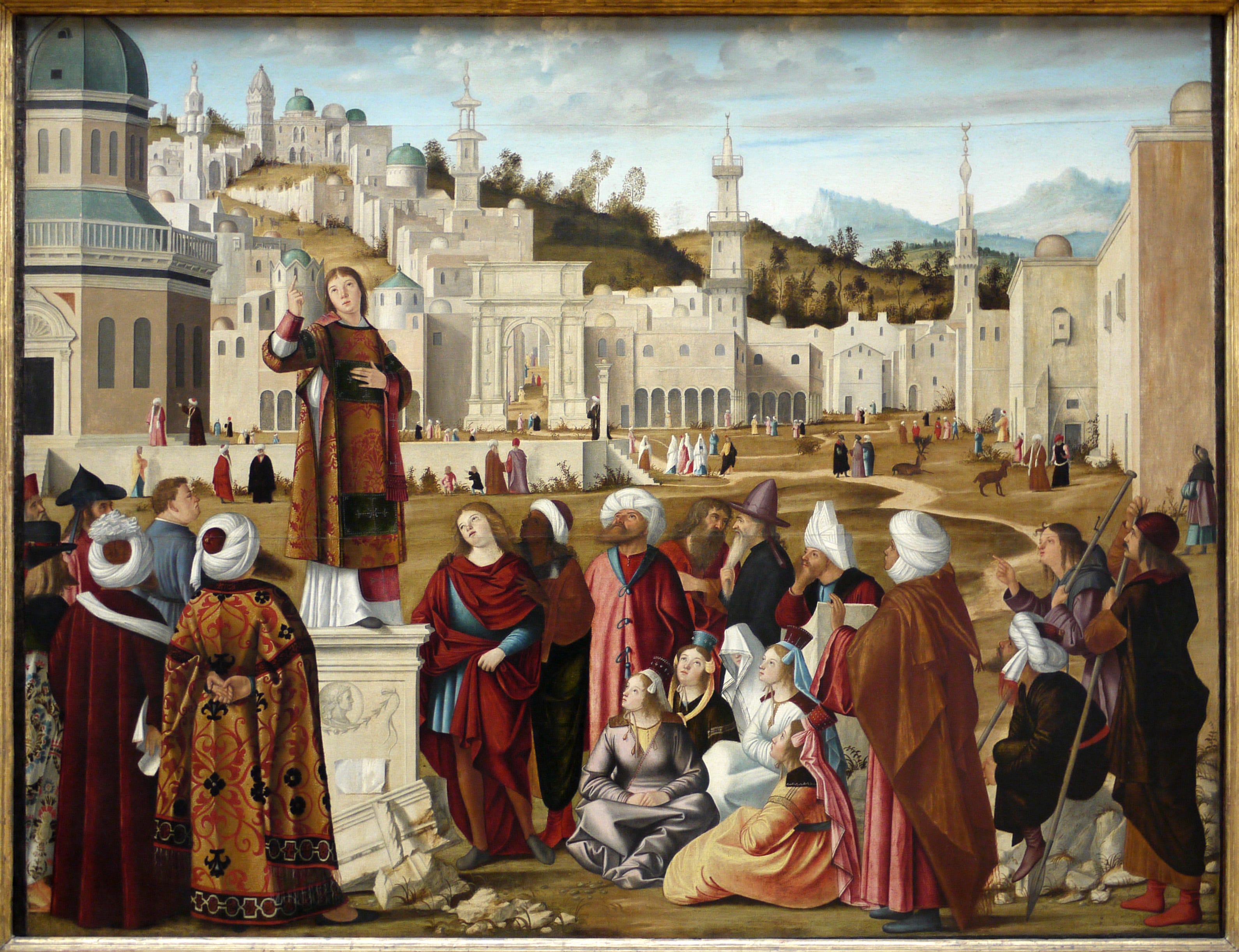
It is my hope that on this Fifth Sunday of Easter, we might all take note from the life of Saint Stephen, and also from the lives of the deacons who may surround us in our pastoral settings today. In the deacon, we find a pastoral friend who can relate to our triumphs and our troubles in the life of the Church. And it is my hope that as the season of Easter starts to draw to a close, we might look to one another with a spirit of renewal. A renewal that can be drawn from the lives of our ministries and a renewal that can be drawn from trust in the providence of our Lord and our God—of Christ, who is our cornerstone.
Ars Musica Sacra is a reader-supported publication. To receive new posts and support our work, consider becoming a free or paid subscriber.
Feast Day Spotlight
Fifth Sunday of Easter—The Church as Structure, Not Just Movement
This Sunday reveals an often-overlooked dimension of the early Church: its rapid move toward ordered ministry.
The institution of the Seven (traditionally associated with the first deacons) is not merely practical—it is sacramental in trajectory. The laying on of hands signals that service itself is taken up into the Church’s visible structure.
By the 3rd century, writers like St. Cyprian of Carthage would insist that unity with the bishop and ordered ministry was not optional, but constitutive of the Church’s life.
A precise line from his On the Unity of the Church clarifies the stakes:
“He cannot have God for his Father who has not the Church for his mother.”
Structure, here, is not bureaucracy.
It is the visible form of communion.
Share these Ars Musica Sacra insights with others for the celebration of this liturgy!
Ars Musica Sacra is supported by readers like you. Join our community and engage with other readers by sharing your thoughts and contributing to community discussions!

Have thoughts on what we shared here? Or maybe questions on some liturgy or theology points? Leave a comment and engage with other readers.