The Baptism of the Lord
When the Voice of God Chooses the Water Instead of the Throne
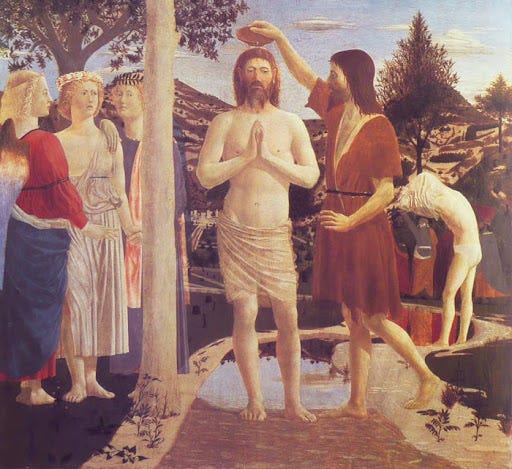
There is something almost disorienting about the way the Baptism of the Lord reveals Christ,
not by elevating Him above the world but by drawing Him directly into its waters, as though the first public act of the Messiah must be one of descent rather than display, humility rather than assertion, silence rather than self-explanation. Jesus does not arrive at the Jordan to distinguish Himself from sinners but to stand among them, and in doing so He sanctifies not only the river but the entire human condition, allowing the weight of history, longing, repentance, and expectation to press against His shoulders before a single miracle has been worked or a single sermon preached.
Isaiah had already prepared us for this kind of Messiah, one whose authority would not announce itself with volume or force, whose justice would arrive without spectacle, whose fidelity would be measured not by how loudly He speaks but by what He refuses to crush. The servant of the Lord does not break the bruised reed or extinguish the smoldering wick because divine power, when it is truly divine, does not need to prove itself by domination. It establishes justice by presence, by endurance, by a patience strong enough to wait until the coastlands are ready to listen. In a world that often mistakes volume for conviction, the Baptism of the Lord reveals a God whose voice is heard most clearly when it does not compete.
And yet the psalm does not let us confuse gentleness with weakness. The voice of the Lord resounds over the waters, mighty and majestic, enthroned above the flood not as a distant ruler but as one whose sovereignty is capable of entering chaos without being overtaken by it. The Jordan becomes the meeting place of thunder and humility, of divine proclamation and human obedience, and it is here—not on a throne, not in the Temple, not before the crowds—that the Father chooses to speak the words that will define Jesus’ entire mission: This is my beloved Son, with whom I am well pleased.
For those entrusted with the Church’s prayer, this moment should feel uncomfortably close. Sacred music lives at this intersection of restraint and revelation, where the voice of the Lord must be allowed to sound without being drowned out by our need for effect, novelty, or affirmation. The Church has long insisted that music is not meant to compete with the liturgy but to serve it from within, shaping hearts so that they can receive what God is already doing. Sacrosanctum Concilium describes the sung prayer of the Church as a form of participation that is both interior and exterior, a discipline of listening as much as of sounding, and the Baptism of the Lord teaches us why: because before Christ speaks, He listens; before He teaches, He submits; before He is exalted, He is named.
Peter’s preaching in the house of Cornelius confirms that this pattern was not accidental but definitive. Jesus’ baptism marks the beginning of a ministry that will cross boundaries, unsettle assumptions, and reveal a God who shows no partiality, a God whose Spirit rests where humility makes room. The same Spirit who descends upon Christ at the Jordan is poured out upon the nations through the Church, not as a badge of superiority but as an anointing for service, a commissioning to “go about doing good,” often quietly, often without recognition, always under the gaze of a Father who sees what the world overlooks.
And perhaps this is the quiet consolation offered to every music minister, cantor, choirmaster, and priest who stands week after week before a people who may not notice the care taken, the hours rehearsed, the fidelity maintained. The Baptism of the Lord reminds us that the most decisive affirmation often comes not from applause or visibility but from obedience lived before God. To sing with reverence, to choose restraint over excess, to allow the liturgy to speak more loudly than our preferences, is to stand in the Jordan with Christ, trusting that when the Church fulfills righteousness rather than chasing relevance, heaven remains open.
Feast Day Spotlight
Color of Vestments
WhiteLiturgical Note
The Baptism of the Lord marks the transition from Christ’s hidden life to His public ministry, revealing Him as the Beloved Son and inaugurating His mission through humility rather than triumph. From the earliest centuries, the Church understood this feast as a manifestation of the Trinity—Father, Son, and Holy Spirit made visible at the Jordan—while also recognizing it as the sanctification of water itself, grounding the Church’s sacramental life in Christ’s own obedience.Historical / Theological Insight
St. Gregory of Nazianzus preached that Christ enters the waters “to bury the old Adam entirely in the water,” reminding us that baptism is not merely symbolic but transformative, a true participation in Christ’s death and life.Why This Matters for Sacred Music
Echoing this, Musicam Sacram teaches that sacred music should foster “active participation” by shaping the interior life of the faithful, aligning the Church’s voice with the humility and clarity revealed at the Jordan, where God speaks not through excess but through truth.
Inspiration from across the internet.
→ the internet was not very inspiring this week
My music of the week.
there are plenty I could link but nothing was pressing on me!